
Item 1 of 2
 ₹https://old-age-homes.antaraseniorcare.com/care-homes/chennai/mappedu/antara-care-home-in-mappedu-chennai--66o7oB/articles/after-a-stroke-the-clock-doesnt-stop-at-discharge--964a6311-ec3d-485c-b98f-1c828f1c767f
Ayya StreetMappedu, chennai600126in08037220962
1505
Antara Care Home, Mappedu, chennai
Premium Old Age Home in Mappedu, Chennai, Tamil Nadu - 600126
08037220962
Request A Call Back
Antara Care Home Social Feeds in Mappedu, chennai
After a Stroke, the Clock Doesn't Stop at Discharge
After a Stroke, the Clock Doesn't Stop at Discharge
Stroke rehabilitation in India is underfunded, under-accessed, and misunderstood. For hundreds of thousands of families, that gap is the difference between recovery and permanent disability.
Bangalore, 07 June, 2026: When a stroke happens, the immediate scramble is to get the patient to hospital. The clot-busting medication, the scans, the ICU. That part of the system, imperfect as it is, exists. What comes after discharge — the months of structured rehabilitation that actually determine how much function a person recovers — largely does not.
Stroke is the fourth leading cause of death and the fifth leading cause of disability in India. The incidence ranges from 119 to 145 per 100,000 population annually, with prevalence consistently higher in urban areas. A significant proportion of strokes in India occur in individuals younger than 65, with approximately 20–30% of cases recorded in those under 50 — numbers that challenge the assumption that stroke is primarily an illness of old age.
The burden is climbing. The infrastructure for recovery is not keeping pace.
Why the first few weeks matter more than most families know
The brain recovers differently from other organs. Its ability to reorganise, form new neural pathways, and compensate for damage — what clinicians call neuroplasticity — is highest in the weeks immediately following a stroke. A meta-analysis of 16 studies found that early rehabilitation within two weeks of ischemic stroke produced significantly better neurological outcomes than late rehabilitation, with measurable improvements across functional independence, motor recovery, and quality of life scores.
Miss that window, and deficits that were recoverable can become permanent. Not because of what the stroke did — but because rehabilitation was delayed, incomplete, or never started.
This is not a clinical abstraction. It plays out in Indian homes every day.
What families actually go through
A stroke does not just disable a patient. It reorganises an entire household.
Among stroke caregivers in India, increased workload, anxiety, and depression were reported by 70–76%, while more than 80% reported significant financial worry. A 2023 cross-sectional study conducted at AIIMS Jodhpur found that nearly half of caregivers reported feeling completely overwhelmed on a daily basis, with 56% making work adjustments and 48% making significant emotional adjustments to manage care at home.
None of these caregivers had clinical training. Most received no formal preparation at discharge. They were handed a patient with complex medical and rehabilitation needs and sent home.
The result is that recovery is inconsistent at best, and at worst it stalls entirely — not because the patient cannot improve, but because the environment cannot support improvement.
The awareness gap nobody is addressing
Ask most families what post-stroke care involves and they will say physiotherapy. A few sessions a week, ideally. What they do not know is that comprehensive stroke rehab is a multidisciplinary program — physiotherapy, occupational therapy, speech and language therapy, neuropsychological support, nutritional management, and continuous clinical monitoring running in coordination over weeks and months.
Paralysis rehabilitation, particularly following spinal injury or neurological damage, follows a similar model. Progress is slow, non-linear, and highly dependent on the consistency of the clinical environment. The gap between what structured rehab delivers and what most patients actually receive in India is wide.
There is also an insurance dimension that goes almost entirely undiscussed. Many health insurance policies in India cover post-hospitalisation rehabilitation — physiotherapy, nursing care, and medically necessary recovery services — for a defined period after discharge. Cashless TPA claims can apply here. For costs beyond coverage, no-cost EMI financing is available through healthcare-focused platforms, allowing families to access structured care without a single large upfront payment. Most families make compromised recovery decisions simply because they do not know these options exist.
The case for a dedicated recovery environment
Most homes in urban India are not set up for stroke or paralysis recovery. There are no grab rails, no clinical beds, no emergency response. A working family cannot provide 24x7 supervision, adapt a rehabilitation protocol in real time, or manage the medication complexity that post-stroke care requires.
Structured recovery in a dedicated facility is not a luxury. For serious neurological cases, it is a clinical requirement.
When Home Is Not Enough
For a stroke or paralysis patient, recovery does not happen passively. It requires daily physiotherapy, occupational therapy to rebuild functional independence, speech and language support where needed, neurological monitoring, and a clinical team that can adjust the program as the patient progresses — or regresses. None of that is available at home. Not consistently, and not safely.
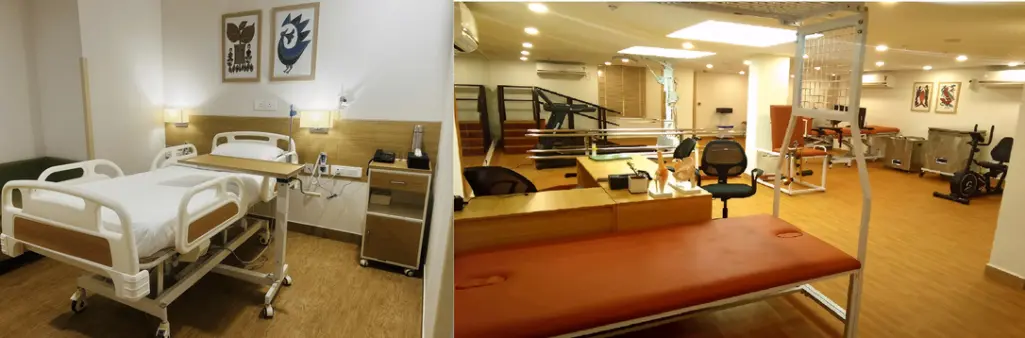
Antara Care Homes provides dedicated stroke rehab and paralysis rehabilitation programs across Delhi-NCR, Bengaluru, and Chennai — with round-the-clock nursing, specialist physician access, neuro physiotherapy, occupational therapy, and clinical pathways aligned with NABH standards. The environment is designed specifically for older adults and serious post-neurological recovery — safe infrastructure, emergency response on-site, and no handoffs between disconnected providers.
Eight Care Homes, over 485 beds. Beyond stroke and paralysis, Antara supports cardiac rehabilitation, post-operative orthopaedic recovery, neuro rehabilitation, pulmonary rehab, and palliative and respite care — one of the few facilities in India where families searching for palliative care near me or long-term neurological rehabilitation find a complete clinical answer.
For families concerned about cost, insurance facilitation is available for eligible post-hospitalisation claims. No-cost EMI financing through Antara's partnership with GMoney means the financial decision does not have to be made under pressure at the worst possible moment.
Recovery after stroke is not guaranteed. But it is significantly more likely — and significantly more complete — when the right environment exists to support it. That environment exists. The gap is in awareness that it does.